You've tried learning to code from free videos, and you keep getting stuck at the same kind of place: the code doesn't work, you don't know why, and there's nobody to ask. A tutor sounds like the answer. Then you search for prices and find everything from $3 to over $100 an hour.
This guide explains where those numbers come from, what you actually get at each price, and how to decide what kind of help you need. The prices below are what we found on the public listing pages of tutoring sites in November 2026. They change often and differ by country, so treat them as ranges, and check the sites themselves before you decide.
The short answer
For one hour of one-to-one programming help, here's roughly what you'll see:
- Low end, $3 to $20 an hour: new tutors on large marketplaces like Preply, often students or tutors in countries with lower living costs.
- Middle, $20 to $60 an hour: most experienced tutors on Wyzant, Wiingy (from about $28) and Superprof (about £15 to £25 in the UK).
- High end, $60 to $115 an hour and more: senior developers and specialists. On Wyzant we saw individual programming tutor profiles from $25 up to $115 an hour.
A third-party price index by Wiingy put the average Wyzant price across all subjects at about $78 an hour in 2026. Programming tutors are spread across the whole range.
So a weekly one-hour lesson costs anything from about $15 to over $400 a month. That's a wide range, and the price alone tells you little about whether a tutor is right for you.
What makes a coding tutor more expensive
Five things move the price more than anything else.
1. Experience and background
A computer science student who learned Python two years ago charges less than a working software engineer. For a complete beginner, that's not always a problem: the student remembers what was hard. For job interview preparation or a specific framework, experience matters more.
2. The topic
Beginner Python, HTML and CSS are the cheapest topics, because many people can teach them. Narrower topics, like a specific database system, data engineering tools or competitive programming, cost more because fewer tutors know them well.
3. Where the tutor lives
Online lessons have made tutoring global. The same hour can cost three times as much from a tutor in a high-cost city as from one in a lower-cost country. Superprof's own price pages show the spread: about C$33 an hour for online coding in Canada and about A$21 to A$22 for programming in Australia.
4. The platform's fee
Marketplaces take a share of each lesson, and some add a booking fee for the student. Part of what you pay goes to the platform, not the tutor. Check whether the price you see is the final price.
5. Package deals and first lessons
Many tutors offer a discounted first lesson or a cheaper rate if you buy several lessons in advance. That's useful once you've found a good match, but only then.
What you actually get for your money
A good human tutor gives you three things that are hard to get anywhere else:
- Questions that fit you. They notice you're confusing a list with a dictionary and change the lesson on the spot.
- Accountability. A booked lesson every Tuesday is a strong reason to practise on Monday.
- Experience you can borrow. They can tell you which part of a course to skip, or what a junior developer job really looks like.
And three things that can disappoint:
- Scheduling. Time zones, cancellations and finding a slot that fits a full-time job.
- Uneven quality. Anyone can create a profile. Reviews help, but a great developer is not automatically a great teacher.
- Watching instead of doing. Some lessons turn into the tutor writing code while you watch. It feels productive, and you remember little of it the next day.
The last one matters most. You learn programming by writing code, getting it wrong and fixing it. An hour where the tutor types is an expensive video.
The alternatives, and what they cost
A one-to-one tutor is one option among several. Here's the honest picture.
Free courses and tutorials: $0
freeCodeCamp, the official Python tutorial, CS50 lectures and countless YouTube channels are excellent and free. Their weakness is the moment you get stuck: there's nobody to look at your code. If you're good at searching for answers and patient with error messages, free material can take you a long way. Our guide to reading error messages helps with exactly that part.
Video course platforms: a monthly subscription or a one-off price
Subscription platforms and one-off video courses give you structure and exercises, usually with automatic tests. Prices vary a lot between platforms and sales, so compare the yearly cost, not only the monthly one. Again, the feedback is limited to "test passed" or "test failed", and nobody explains why your particular code went wrong.
Bootcamps: usually thousands
Full-time or part-time bootcamps usually cost thousands of dollars or euros, with live teaching and career support. They make sense for someone who has already decided to change careers and can commit months of time. They're a big commitment for someone still finding out whether they enjoy coding.
General AI chatbots: free to about $20 a month
ChatGPT, Claude and similar assistants answer coding questions instantly. The problem for a learner is that they answer too well: you paste broken code, you get working code, and you've learned nothing. You can make them better teachers with the right habits. Our guide on learning to code with AI without letting it think for you covers six rules that work.
AI tutors built for teaching: often a few dollars per session
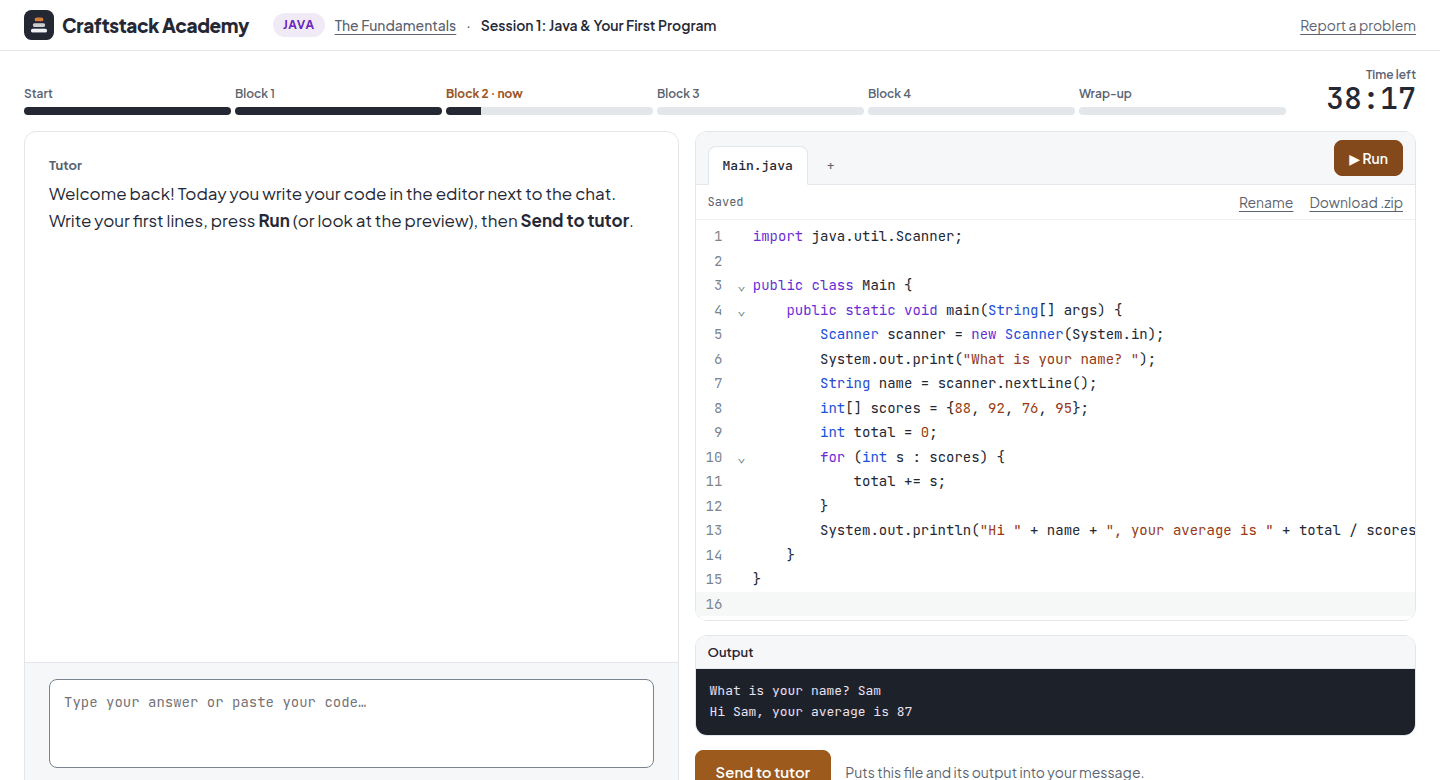
A newer option sits between a chatbot and a human tutor: an AI tutor that follows a lesson plan, reads the code you actually typed, and gives hints instead of answers. You get feedback at any hour, with no scheduling. You don't get a human's career advice or someone noticing you look tired. Prices differ between services, but many cost a few dollars or euros per session, well below most human tutors.
How to decide what you need
Answer three questions honestly.
1. What do you get stuck on?
- "I don't know what to learn next." You need structure: a course or a learning path.
- "My code doesn't work and I don't know why." You need feedback on your own code: a tutor, human or AI.
- "I understand the code but I don't practise." You need accountability: scheduled lessons, a study partner or a fixed weekly slot.
2. What's your goal?
- Trying coding to see if you like it: start free or very cheap. Don't buy 20 lessons up front.
- Learning for your current job (automating spreadsheets, writing SQL reports): a short, focused course plus help when you're stuck.
- Changing careers: a structured path, lots of practice and, at some point, a human mentor who works in the industry.
3. How much time do you have each week?
A tutor can't create practice time. One focused hour a week with practice in between beats three rushed hours you never follow up. With a full-time job, a fixed weekly slot plus one or two short practice sessions is a realistic rhythm.
Three example budgets
To make the numbers concrete, here's what a month of learning can look like at three budgets, for a beginner with about two hours a week:
- $0 a month. A free course for structure, the official documentation, and forums for questions. It works if you're patient with being stuck. Plan extra time for searching and reading error messages.
- Around $50 a month. A free or cheap course for structure, plus one or two hours with a mid-priced human tutor for the problems you can't solve alone. Save your questions during the month and bring them to the lesson.
- Around $200 a month. A weekly lesson with an experienced human tutor, with practice in between. This is where accountability is strongest, and it suits people who know they won't practise without a fixed appointment.
None of these is the right answer for everyone. The best budget is the one you can keep for three months, because that's roughly how long it takes to see whether coding is for you.
How to get the most out of a paid hour
Whatever you choose, these habits make each hour worth more:
- Come with code. Bring the program you tried and the exact error message, not "I don't get loops".
- Type everything yourself. If the tutor shares their screen, ask them to guide you while you type.
- Ask "why", not "what". "Why does this need
int()?" teaches more than "What do I write here?" - Write down one thing you learned at the end of each hour, in your own words.
- Practise before the next lesson, even for 20 minutes. Without it, the next hour starts with repeating the last one.
Questions to ask a human tutor before you book
- "What would the first three lessons cover for someone at my level?"
- "Do I write the code during the lesson, or do you?"
- "Can I see a short example of how you explain an error?"
- "What do I do between lessons?"
- "What's your cancellation policy, and are there platform fees on top?"
A good tutor answers these easily. Vague answers are a warning sign.
Red flags
- Promises like "job-ready in 4 weeks" or guaranteed salaries.
- Pressure to buy a large package before the first lesson.
- Lessons that are mostly the tutor's screen.
- No plan: every lesson starts with "So, what do you want to do today?"
Frequently asked questions
How much does a Python tutor cost per hour?
On the marketplaces we checked in November 2026, beginner Python tutoring ranged from under $10 to over $100 an hour. Most experienced tutors charged between $20 and $60.
Are cheap tutors worth it?
Sometimes. For beginner topics, a cheaper tutor who explains clearly and lets you type can be a great deal. Book one lesson first and judge by how much you could do alone afterwards.
Is an online coding tutor as good as one in person?
For programming, usually yes. You both need a screen anyway, and online widens your choice of tutors and prices.
How many lessons do I need?
It depends on your goal. One estimate, from the training company Noble Desktop, is 20 to 40 hours of study to write basic Python scripts. Our guide to how long it takes to learn Python breaks that down week by week.
Can an AI tutor replace a human tutor?
For practising the basics and getting unstuck on your own code, it can do much of the work for much less money. For career advice, mentoring and a person who knows you, a human is still better. Many learners combine both: AI for daily practice, a human for occasional big questions.
A quick checklist
- Decide what you're stuck on: structure, feedback or accountability.
- Set a monthly budget before you browse profiles.
- Compare the final price, including platform fees.
- Book one lesson first, not a package.
- Make sure you write the code yourself during the lesson.
- Practise between sessions.